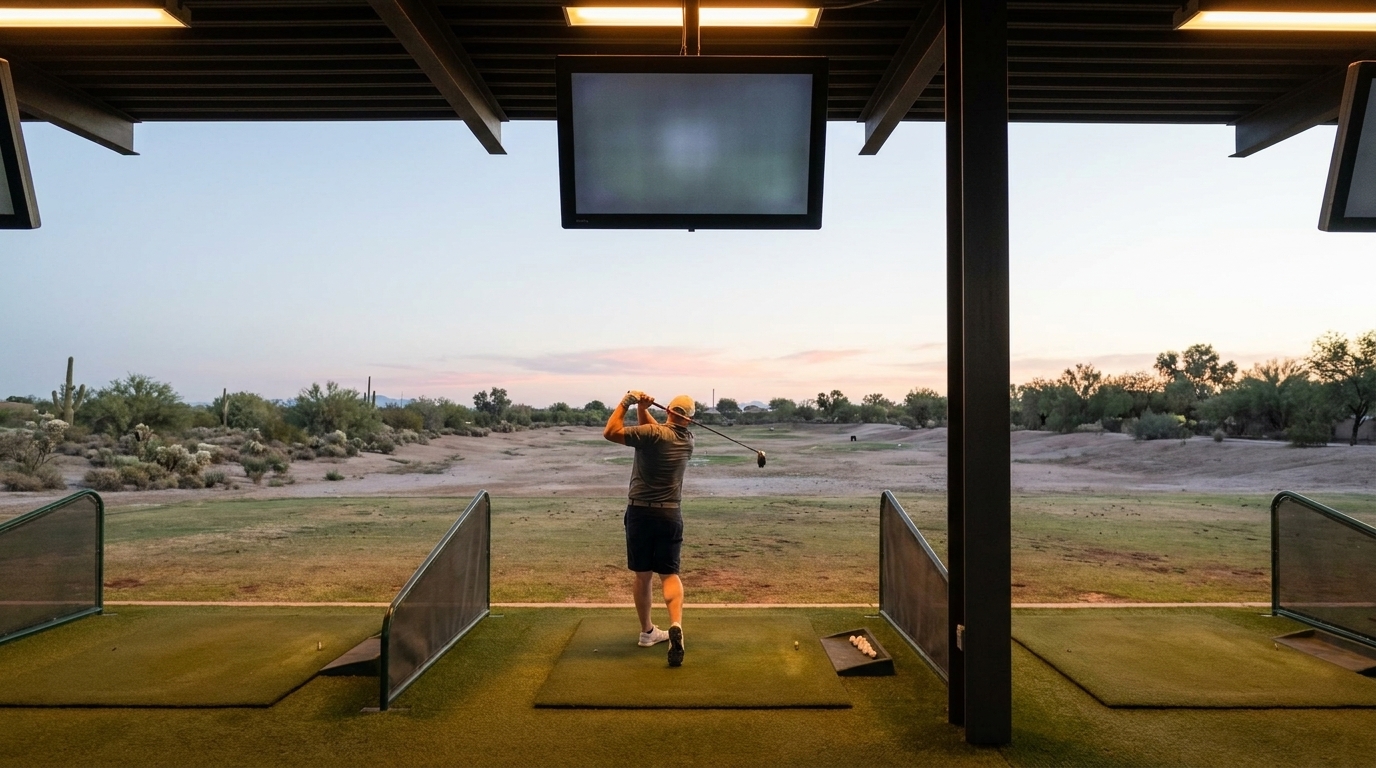
So you live in Eastmark, you've got a few clubs in the trunk, and your swing feels like it's held together with duct tape and hope. Welcome to the club. Literally.
Here's the thing about driving range practice: most golfers do it wrong. They grab a large bucket, pull out the driver, and start launching balls toward the back fence like they're being timed. An hour later, they're sweaty, frustrated, and somehow worse than when they started. Sound familiar?
Good news — improving your golf swing at the driving range is absolutely doable. You just need a plan. And maybe a little shade, because this is Mesa.
Why Driving Range Practice Beats Course Time (When You Do It Right)
Playing 18 holes is fun. It's also a terrible way to fix a swing. You hit one shot, walk 200 yards, hit another, deal with a tree, putt for double bogey, repeat. That's not practice. That's golf-flavored cardio.
The driving range gives you something the course can't: repetition. You can hit 40 seven-irons in 20 minutes and actually feel what's working. For Eastmark golfers — many of whom moved here for the year-round sunshine and the easy access to courses across east Mesa — that repetition is gold.
And in our climate? You can practice 10 months a year without weather excuses. Try that in Minneapolis.
Show Up With a Plan (Not a Bucket of Hope)
Before you hit a single ball, decide what you're working on. One thing. Maybe two. Not seven.
- Tempo — are you swinging like someone stole your wallet?
- Contact — fat shots, thin shots, or that weird shank that haunts your dreams?
- Direction — slicing it into the next zip code?
- Distance control — knowing how far each club actually goes
Pick the issue. Pick the club. Then build a session around it. We promise this works better than spraying drivers for 45 minutes.
The Practice Structure That Actually Works
1. Warm Up Like You Mean It
Start with wedges. Half swings. Slow tempo. Ten to fifteen balls just to wake up your body — this matters more in Eastmark because morning rounds in summer mean you're already fighting heat by the time you swing. Loose muscles, fewer injuries, better feedback.
2. Block Practice First
Block practice means hitting the same club, the same shot, over and over. Boring? A little. Effective? Massively. Spend 20-30 balls grooving one motion — say, a controlled 7-iron at 80% effort. You're training the body to repeat.
3. Random Practice Second
Now switch clubs every shot. Wedge. Driver. 6-iron. Hybrid. Wedge again. This mimics what actually happens on the course. Research on motor learning has been clear for decades — random practice transfers to performance better than block practice alone. Do both.
4. Play Imaginary Holes
The last 15-20 balls of your session? Pretend you're playing the front nine. Tee shot with the driver. Approach with a 9-iron. Penalty shot from the rough with a wedge. Score yourself. This is how range practice becomes course-ready practice.
Drills That Actually Move the Needle
The Alignment Stick Drill
Lay one stick along your toes, another pointing at your target. Most amateurs are aimed 20 yards right or left of where they think. Fix this before anything else.
The Pause Drill
At the top of your backswing, pause for one full second before swinging down. Forces you to actually feel the transition instead of yanking the club like you're starting a lawnmower. Great for tempo. Great for sequencing.
The 50% Swing
Hit every shot at half effort for a full bucket. You'll be shocked how far the ball still goes — and how much better your contact gets. Power comes from sequence, not effort.
The One-Club Round
Take only your 7-iron. Hit it high. Hit it low. Hit it short. Hit it full. Learn what one club can really do. This builds shot-making feel that translates everywhere.
Use Technology — But Don't Let It Run You
Modern range facilities around Mesa have shot-tracking tech that tells you carry distance, ball speed, spin, launch angle, and your dating history. It's incredibly useful. It's also easy to obsess over.
One reviewer of Dobson Ranch Golf Course on Mill Road described the practice setup as having "shot tracker and multiple courses available right from the practice bays" — and shaded bays, which in Mesa from May through September is less a luxury and more a survival feature. Use the data to confirm what your swing is doing, not to chase numbers. Trying to hit your driver 5 mph faster on every swing is how you wreck your back and your scorecard.
Mesa-Specific Practice Considerations
Eastmark golfers deal with conditions that genuinely affect how you should practice:
- Heat — May through September. Practice early. Like, 6 a.m. early. Hydrate before you start, not when you're already cooked. Shaded bays change the game.
- Dry air affects ball flight. Your ball flies a little farther here than it would in humid climates. Adjust your distance expectations when you travel.
- Bermuda grass everywhere. Most Mesa courses and ranges use Bermuda, which sits up differently than the cool-season grasses you might've grown up on. Practice off the same turf you'll play on.
- Snowbird season — November through March. Ranges get crowded. Book your bay or go off-peak (weekday mornings after 9, or evenings).
How Often Should You Practice?
Two focused 45-minute sessions per week beats one three-hour marathon. Your brain absorbs more in shorter, intentional reps than in one exhausting session where the last 80 balls are just you flailing.
If you can sneak in a third short session — even 20 minutes of wedge work — you'll see improvement inside a month. Real, measurable improvement. Lower scores. Better contact. Less swearing.
FAQ: Driving Range Practice in Eastmark
Is hitting driver every ball a good idea?
No. Drivers magnify swing flaws and exhaust your body. Mix in wedges, mid-irons, and hybrids. A balanced bucket builds a balanced game.
How long should a range session last?
45 to 75 minutes is the sweet spot. Beyond that, focus drops and you start grooving bad habits. Quality over quantity, always.
Should I take lessons or just practice more?
Both. Practicing the wrong move 1,000 times just makes you really good at the wrong move. A few lessons with a PGA pro will tell you what to actually work on. Then the range becomes way more productive.
What's the best driving range near Eastmark?
For Eastmark residents, Dobson Ranch Golf Course is a short drive west into central Mesa and has invested heavily in its practice facilities — multiple bays, shot tracking, and shade matter more than people realize until they've practiced in 108-degree heat.
Can I really improve without a coach?
You can improve some. But you'll plateau faster. Even one lesson every couple of months keeps you from drifting into bad habits during solo practice.
Putting It All Together
Driving range practice works when it's intentional. Show up with a goal. Warm up properly. Do block work, then random work, then play imaginary holes. Use the tech without letting it boss you around. And in Mesa, respect the heat — your swing improves faster when you're not heatstroked.
Eastmark golfers looking for a practice facility with shaded bays, shot tracking, and a course attached for when you're ready to test your work can reach Dobson Ranch Golf Course at https://www.dobsonranchgolfclub.com/ for hours, range details, and tee times. Bring your A-game. Or don't. The range is where you build it anyway.