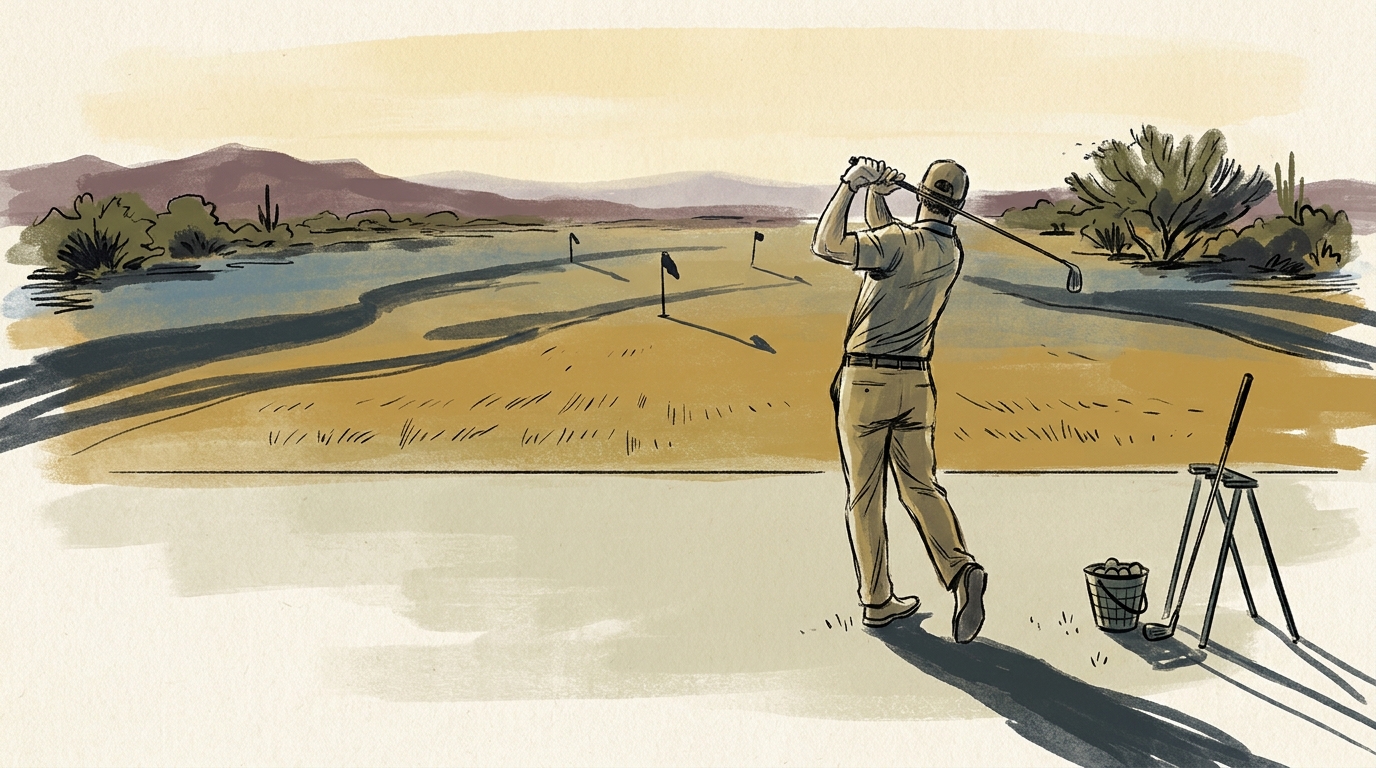
You've been grinding. You track every round. And your handicap? Still stuck. If you're a Gilbert golfer chasing single digits — or just trying to break 90 — you don't need more range balls. You need smarter reps, better strategy, and a plan built for our desert reality.
Here's how to actually drop your handicap fast without quitting your day job.
Why Gilbert Golfers Have a Real Advantage
Let's start with the good news. Gilbert sits in one of the most playable climates in the country. From October through May, conditions are golden. Firm fairways. True greens. Sunshine on repeat.
That's roughly seven months of prime improvement season. Snowbird months (November through April) can crowd tee sheets, so early-morning or twilight practice becomes your best friend.
Summer? Yes, it's hot. But 5:30 a.m. tee times, shaded practice bays, and cooler evenings after 6 p.m. keep the work going year-round. Gilbert golfers who play through July and August often see the biggest gains — because everyone else stopped.
Step 1: Know Your Real Miss (Not Your Story About It)
Most Gilbert golfers think they need to hit it farther. Most actually need to stop the double bogeys.
Track your last five rounds. Count:
- Penalty strokes (water, OB, unplayable)
- Three-putts
- Duffed chips inside 30 yards
- Missed greens from inside 150 yards
Whichever number is biggest? That's your handicap killer. Fix that first. Everything else is noise.
Step 2: Build a Practice Routine That Actually Moves the Needle
Beating balls on the range feels productive. It rarely is. A focused 60-minute session beats three unfocused hours every time.
The 60-Minute Handicap-Drop Routine
- 10 minutes putting — Only 3 to 6 footers. This is the range where handicaps live and die.
- 15 minutes short game — Basic chips and pitches from 10, 20, and 30 yards. Same club. Same setup. Repeat.
- 20 minutes wedge and mid-iron work — Pick a target. Hit to it. Miss? Figure out why before the next ball.
- 10 minutes driver — Not for distance. For fairways. Play a "fairway or fail" game with a 30-yard-wide imaginary corridor.
- 5 minutes bunker — Yes, five minutes. Consistency beats novelty.
Practice facilities at Dobson Ranch Golf Course are built for exactly this kind of session — shaded bays, shot-tracking technology, and short-game areas within a few steps of each other. One recent reviewer put it simply: "They have invested heavily in their practice facilities with shot tracker and multiple courses available right from the practice bays."
Step 3: Play Smarter, Not Harder
Here's the truth nobody tells mid-handicappers. You don't need better swings. You need better decisions.
Course Management Wins Strokes for Free
- Aim for the fat side of every green. Pin-hunting is how bogeys become doubles.
- Club up. Amateurs come up short of the green roughly 80% of the time. Take one more club. Swing smoother.
- Lay up to your favorite yardage. If you love your 100-yard wedge, don't leave yourself 63.
- Never compound a mistake. One bad shot is a bogey. Two bad shots trying to save it is a triple.
Play nine holes in Gilbert with this mindset and you'll shave strokes without changing a single swing.
Step 4: Get Custom-Fit Data on Your Own Bag
You probably don't actually know how far your 7-iron goes. You know how far your best 7-iron goes. Big difference.
Spend one session with a launch monitor and log the average carry distance for every club. Then play those numbers, not your ego numbers. In Arizona's dry air, the ball flies a touch farther than in humid climates — so your distances here won't match a YouTuber in Florida. Local reps matter.
Step 5: Play More Competitive Rounds
Casual rounds with mulligans don't lower handicaps. Rounds where every shot counts do.
Options in Gilbert:
- Join a men's or women's club at a local public course
- Enter a weekend skins game
- Play a monthly tournament
- Post every score to your GHIN, good or bad
Pressure exposes weaknesses. Weaknesses, once exposed, become fixable. Dobson Ranch Golf Course regularly hosts tournaments and events across the East Valley, and reviewers frequently note the well-run experience — one wrote, "Great event! Great host!"
Step 6: Fix Your Body, Not Just Your Swing
Gilbert's dry heat is deceptive. You dehydrate faster than you think, and tired golfers make sloppy swings on the back nine.
- Drink water before you're thirsty
- Electrolytes on any round above 90°F
- Stretch your hips and thoracic spine — desert-stiff golfers lose rotation fast
- Sunscreen. Seriously. Every round.
Any advantage you can gain physically shows up on holes 14 through 18, which is exactly where handicaps get made.
Step 7: Pick a Home Course and Learn It Cold
Handicap improvement accelerates when you know a course intimately. You stop guessing yardages. You know which greens roll fast. You know the safe miss on every hole.
Dobson Ranch Golf Course, tucked in the East Valley within easy reach of Gilbert neighborhoods, is a mature, tree-lined layout — the kind one reviewer described as "a fun golf course without the desert penalty." Translation: fewer lost balls in cactus, more chances to score. That's a real edge when you're trying to post consistent numbers.
Learning one course's quirks — the fast greens, the sneaky pin positions, the wind that picks up around 3 p.m. in spring — turns rounds you'd shoot 92 into rounds you shoot 87.
Frequently Asked Questions
How fast can I realistically lower my handicap in Gilbert?
A committed golfer practicing 2 to 3 times per week with a smart routine can drop 3 to 5 strokes in a season. Bigger drops (6+) usually require lessons plus consistent play.
Should I take lessons or just practice more?
Both — but lessons first. Practicing a broken swing just grooves the broken swing. Even two or three lessons to fix major flaws can pay off for years.
What's the best time of year to work on my game in Gilbert?
October through April is prime. Cooler mornings, firm turf, and consistent conditions make it easier to build repeatable habits. Summer is great for early-morning short-game work when the range is quiet.
How often should I play versus practice?
A healthy ratio for improvement is roughly 2 practice sessions per 1 round played. Pure players plateau. Pure grinders never learn to score. Mix both.
Does the ball really fly farther in Arizona?
Yes — dry desert air is thinner than humid coastal air, and elevation adds a small boost too. Expect a few extra yards on full shots compared to sea-level humid climates. Dial in your actual carry distances here rather than trusting online averages.
The Bottom Line
Lowering your handicap isn't about magic drills or a new driver. It's about honest tracking, focused practice, smart course management, and consistent competitive play — all supported by good facilities and a course you can learn cold.
Gilbert golfers who want a home base with strong practice facilities, well-maintained conditions, and a team that runs a tight ship can visit Dobson Ranch Golf Course at dobsonranchgolfclub.com to book a tee time, reserve a practice bay, or ask about upcoming tournaments. It's the kind of place where the reps you put in actually translate to lower scores.
"