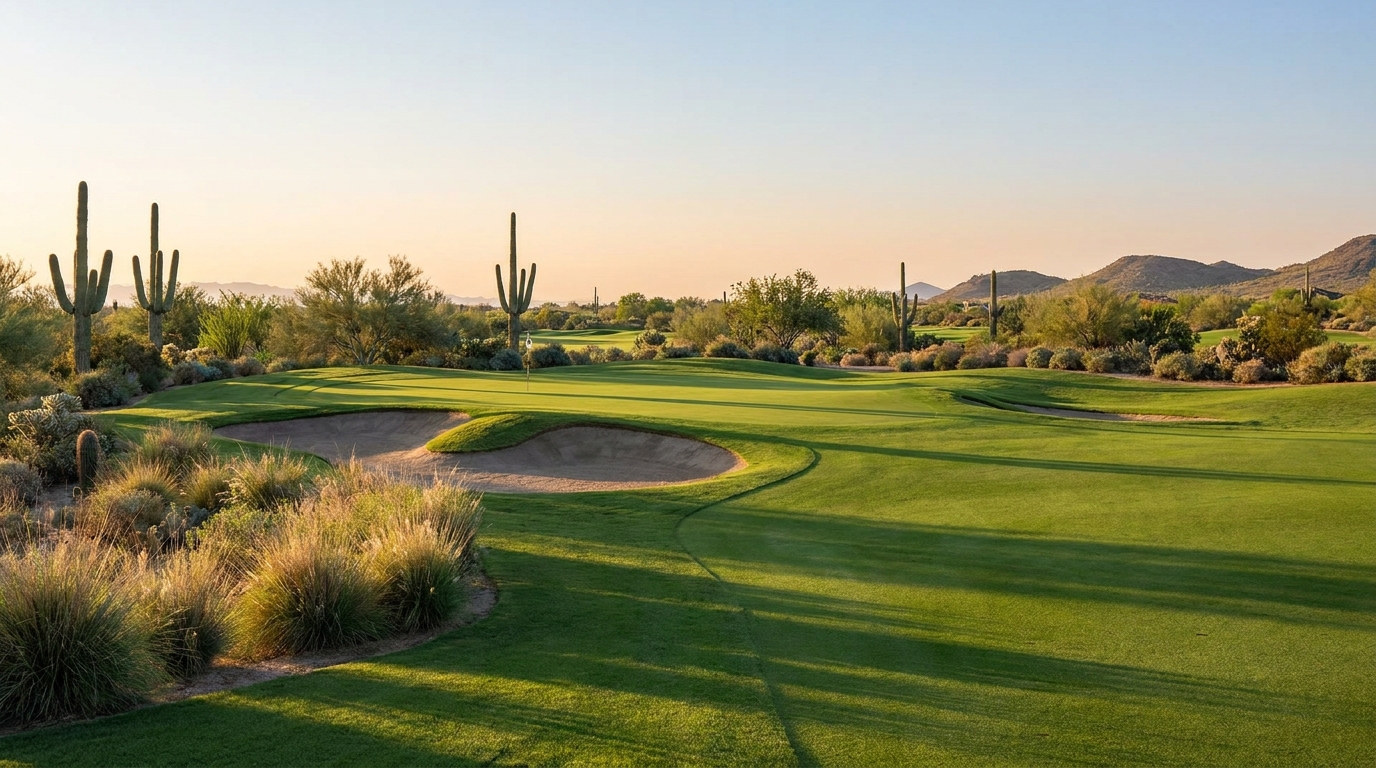
You've seen the phrase plastered on scorecards, signage, and golf travel sites: championship course. But what does it actually mean? Is it a marketing label? A formal designation? A hint that you're about to lose a sleeve of balls before the turn?
Fair questions. Let's clear it up.
Whether you're a weekend hacker in Gilbert, AZ or a low-handicap player hunting your next round, knowing what separates a championship layout from a standard public course helps you pick the right tee time — and set the right expectations.
What Does "Championship Golf Course" Actually Mean?
Here's the honest answer: there's no single governing body that stamps a course as "championship."
It's not like a Michelin star.
Instead, the term refers to a course built — or renovated — to meet the design standards required to host competitive tournament play. Think regional qualifiers, college events, state amateur championships, and in some cases professional tours.
So when a course calls itself a championship layout, it's signaling that the design, length, conditioning, and infrastructure can hold up to serious competition. Not just a casual loop with a snack bar.
Championship Golf Course Standards: The Core Criteria
A few specific markers separate championship-grade courses from standard daily-fee tracks. Here's what to look for.
1. Length and Multiple Tee Boxes
Championship courses are built to substantial lengths from the back tees, prioritizing distance as a key design element. But length alone isn't the point — it's the range of tees.
You'll usually find multiple sets of tees, letting a junior, a senior, a scratch player, and a tournament pro all play the same holes at appropriate distances.
That flexibility is part of the standard.
2. Strategic Design, Not Just Hazards
This is where championship vs standard golf course design really diverges.
A standard course might have hazards scattered around. A championship course uses them strategically — bunkers placed at typical landing zones, water that forces a real decision off the tee, green complexes that reward the correct angle of approach.
Every hole should pose a question. The better you play, the more questions you get to answer.
3. Green Complexes Built for Speed and Variety
Championship greens are typically:
- Larger and more contoured
- Built to roll at faster speeds during events
- Designed with multiple pin positions that completely change strategy
A standard public course might have flatter, more forgiving greens. Championship layouts make putting a skill — not a formality.
4. Conditioning and Agronomy
This is huge, especially in the East Valley.
Maintaining championship-level turf in the Sonoran Desert is no joke. Maintaining championship-level turf through the intense desert summer heat and the seasonal overseed transition is a make-or-break window for course conditions across Gilbert, Mesa, and Chandler.
Championship-standard courses invest heavily in:
- Consistent fairway cuts
- Tight lies and clean rough lines
- Bunker sand quality and drainage
- Greens that putt true year-round
5. Practice Facilities That Match the Course
You can't host real competitive play without a real practice facility.
Championship-grade courses usually include a full driving range with target greens, a short-game area, a putting green that mirrors the course's speed, and increasingly, shot-tracking technology in the bays.
Standard public courses might have a mat range and a putting clock. Big difference.
Championship Course Features Explained: What You'll Notice as a Player
Walk onto a championship-caliber course and you'll feel it before you tee off. A few tells:
- Defined holes. Each one has its own personality. No two feel like the same dogleg.
- Visible shaping. Mounding, framing, sightlines from the tee that tell you where to aim.
- Maintained rough. Not just "whatever grew this week."
- Cart paths and signage. Pace-of-play matters in tournament settings, and the infrastructure shows it.
- Pro shop and staff depth. Tournament hosting requires people who know how to run events.
At Dobson Ranch Golf Course in Mesa — right next door to Gilbert — the staff, practice facilities, and hole-to-hole variety consistently earn praise from players. The course draws repeat visitors who note the design variety you'd expect from an 18-hole championship layout. One customer wrote: "the food, range, and service were all outstanding." That kind of variety is a championship marker.
Championship vs Standard Golf Course: The Honest Tradeoffs
Championship doesn't automatically mean "better for you."
It means more demanding. Longer carries. Faster greens. More penalty for missed shots. If you're a 25-handicap looking for a fun afternoon, a wide-open standard course might genuinely be more enjoyable.
The sweet spot? A championship-design course with forward tees that let casual players have fun without getting eaten alive. That's what a well-run public championship course delivers — accessibility on top of pedigree.
Why This Matters for Golfers in Gilbert, AZ
The East Valley has a deep bench of golf options, from resort-style desert layouts down in Queen Creek to municipal tracks tucked into older Mesa and Tempe neighborhoods. Knowing which kind of course you're booking matters for three reasons:
- Pricing expectations. Championship-standard courses cost more to maintain, and green fees reflect that — especially during the snowbird stretch from November through April when demand peaks. Contact Dobson Ranch Golf Course directly for current rates.
- Tee time strategy. Summer twilight rounds on a championship course in the Phoenix metro can be the best value in golf. Cooler temps, lower rates, full conditioning.
- Practice routines. If you're working on your game seriously, a course with championship-grade practice facilities saves you driving across the Valley for a real range session.
FAQ: Championship Golf Courses
Is a championship course harder than a regular course?
Generally yes — from the back tees. But most are designed with multiple tee boxes so players of any skill level can find an appropriate challenge.
Do you need to be a member to play a championship course?
Not at all. Many championship-caliber courses in the Gilbert and Mesa area are public, daily-fee facilities open to anyone with a tee time.
What's the difference between "championship" and "PGA tournament" courses?
Championship is the broader design category. PGA tournament venues are a specific subset that has hosted (or is built to host) professional tour events. All PGA venues are championship courses; not all championship courses host PGA events.
How can I tell if a course is truly championship-grade before I book?
Check the yardage from the back tees, look at the practice facility, read recent reviews for conditioning notes, and see whether the course hosts amateur tournaments, college events, or qualifiers.
Does shot-tracking technology at a driving range matter for serious practice?
Yes — significantly. Knowing your launch angle, ball speed, and carry distance after every swing turns repetition into informed practice. Championship-grade facilities increasingly include this kind of technology in their range bays. Dobson Ranch Golf Course's Smashers On Driving Range uses Inrange-powered bays that deliver exactly that data, alongside food and drinks served right to your bay.
Can families and beginners enjoy a championship course, or is it only for serious golfers?
A well-designed championship course welcomes all skill levels. Multiple tee boxes let beginners play shorter, more manageable distances, while forward tees keep the round fun rather than frustrating. Dobson Ranch Golf Course, open since 1974, pairs its championship layout with amenities like The Stable putting course — where kids play free every day — making it genuinely family-friendly alongside its competitive pedigree.
The Bottom Line
"Championship" isn't a gimmick — but it isn't a guarantee either. It's a design and maintenance standard that signals a course is built for serious play while still being playable for the rest of us.
If you're in Gilbert, AZ and want to experience what a championship-design public course feels like — uniquely shaped holes, invested practice facilities, the kind of staff that runs tournaments and birthday outings with the same care — Dobson Ranch Golf Course is right next door in Mesa. You can browse rates, check tee times, and see the course at dobsonranchgolfclub.com.
Bring your A-game. Or don't. The forward tees are friendly.
"